
The 2026 AbSec Child & Family Conference has concluded on Birpai Country in Port Macquarie, with more than 400 Aboriginal leaders, ACCOs, researchers, carers, policymakers and frontline workers uniting behind strong calls for urgent, structural reform of the NSW child protection system.
Held over three days from 25–27 August under the theme Stronger Together: Uniting Voices, Empowering Futures, the conference brought together more than 60 speakers across 40 sessions to put AbSec’s State of the ACCO Sector findings, Aboriginal-led solutions and the case for an independent NSW Child Safety and Wellbeing Commission before sector leaders from across Australia.
AbSec CEO John Leha said the scale of attendance reflected both the strength of the sector and growing recognition that reform cannot wait, “there is something incredibly special about bringing more than 400 people together on Birpai Country with a shared commitment to our children and families,” Mr Leha said. “Our communities know what keeps our children safe. We have strong Aboriginal organisations, growing evidence and solutions already working on the ground. The challenge now is whether governments are prepared to back those solutions with the authority, resources and accountability needed to make them work at scale.”
Three days of truth-telling and solutions
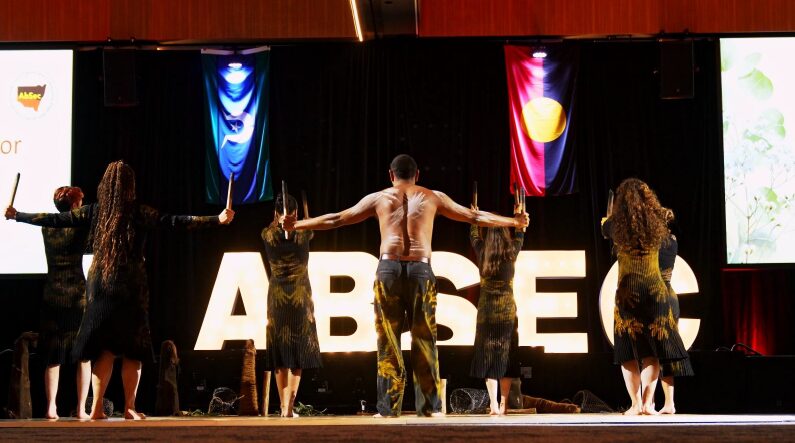
The conference opened with Uncle Bill O’Brien’s Welcome to Country and a performance from the Yapun.Yapun Biingay dancers of Wauchope High School, before Mr Leha set the tone for the conference: “In New South Wales, our children are removed from their homes at more than 11 times the rate of non-Aboriginal children, and we have the worst level of reuniting our children with their families in the country. These are our babies. Our kids. Our nieces and nephews, our future leaders and Elders. What they represent is another Stolen Generation, unfolding in real time, in front of our eyes.”
National Commissioner for Aboriginal and Torres Strait Islander Children and Young People, Sue-Anne Hunter, delivered a keynote address that focused on the Aboriginal and Torres Strait Islander Child Placement Principle, telling delegates that “the government holds a responsibility to apply the principle properly to the standard” and in reference to NSW, the Commissioner noted that “legislation alone has not delivered the transformation our children and families need. The system remains fragmented, with gaps in accountability and coordination across government and non-government services.”
The Commissioner added her voice to calls for an independent Child Safety & Wellbeing Commission in NSW, describing the proposed body as one that would be independent of government and focused specifically on oversight of the child protection system for Aboriginal and non-Aboriginal children, and creating clearer and more independent accountability for the safety and wellbeing of children and young people.
Day One also brought the Child Protection Assessment Partnership panel discussion, featuring the Department of Communities and Justice (DCJ), the Aboriginal Legal Service and AbSec. John Leha facilitated a panel bringing together Fiona Small and Bianca Jarrett from the Department of Communities and Justice, Zoe De Re from the Aboriginal Legal Service and AbSec’s Sherry-Ann Toomey. The discussion explored how the three agencies are working towards a common goal: a more transparent, accountable and culturally responsive child protection system that works with Aboriginal children, families and communities, builds on their strengths and brings Aboriginal knowledge and perspectives into assessment and decision-making.
Day Two turned to governance and healing. Aunty Muriel Bamblett of VACCA, Wendy Moore of the Tasmanian Aboriginal Centre and John Leha shared hard-won lessons on delegated authority, while Aunty Debra Swan and Barry McGrady introduced Fish Trap Theory — First Nations governance as relational law, grounded in balance, flow and sustainability. Delegates also sat with Kinchela Boys Home Aboriginal Corporation on healing and identity, heard the case for a Charter of Lifelong Recordkeeping Rights, and heard updates and progress of AbSec’s Leaving Care Hub. The afternoon carried a strong thread of community-led reform, from VACCA and BDAC’s Nugel initiative to the Latrobe Valley Koorie Partnership and Aboriginal-led commissioning on Wiradjuri Country.
A night to celebrate: 2026 AbSec Awards
The conference’s Gala Dinner and Awards Night celebrated the people and organisations going above and beyond for Aboriginal and Torres Strait Islander children, families and communities, with more than 50 nominations received this year. Crystal Bell took out Community Member of the Year, while Daniel Daylight, CEO of Mounty Aboriginal Youth & Community Services (MAYCS), won the Legal & Justice Award. Marg Sutherland was named Practitioner of the Year after five decades in early childhood development, and 11-year-old Patisha Gordon — school vice-captain, advocate for her four siblings living with disability, and already a Young Leaders Conference delegate — was named Young Person of the Year. Durri Aboriginal Corporation Medical Service took home ACCO of the Year for its work co-designing maternal and child health services with community, and One Mob Connection, a volunteer-led group from Wagga Wagga, won ACCM of the Year. Charmaine Mara and Alicia Ball were joint winners of the Deadly Advocate of the Year award, while Nicky and Barry (Carer of the Year), Pathfinders (Walking Together Award) and Kasey Hosie (Early Educator of the Year) were also recognised for their contributions to the sector.
Day Three centred on restoration, with Associate Professor BJ Newton presenting landmark research on family restoration outcomes, before AbSec Board Chair Petrice Manton closed the conference, reflecting on three days that held “both hard truths and hope” and describing the growing reach of Aboriginal-led commissioning and Aboriginal Community-Controlled Mechanisms as proof “this is self-determination in action.
New AbSec tools launched to drive accountability
The conference provided a platform for sector wide engagement and an opportunity for AbSec to call for reform with new, practical tools for the sector to hold the system to account. The standout announcement came on Day Two, with the launch of two landmark Aboriginal-led Commissioning (ALC) initiatives on Wiradjuri Country in Western NSW, developed with the Wiradjuri Condobolin Corporation, and a second pilot site in Grafton. The initiatives put real governance authority in the hands of Aboriginal communities, Elders and families, giving them the power to drive solutions for their own children and communities — a practical demonstration of what self-determination looks like when it moves from policy to practice.
AbSec also unveiled its redesigned child protection data dashboard, built in partnership with DCJ to give the sector clearer, real-time visibility of the funding, service gaps and outcomes driving decisions about Aboriginal children and families.
State of the ACCO Sector: the evidence behind the calls
The renewed calls for reform are grounded in stark findings from AbSec’s State of the ACCO Sector report: non-ACCO NGOs received six times more funding than ACCOs over the past four years ($5.1 billion compared with $797 million), 86% of that funding goes to out-of-home care rather than early support, and just 2% of Aboriginal children in care were reunified with family in 2024–25 — the worst rate in the country, and worsening.
“We have strong Aboriginal organisations, community knowledge and clear evidence about where the system is falling short,” Mr Leha said. “What we need now is the authority, resources and accountability to turn that evidence into better outcomes for children and families.”
Reform must be backed by independent oversight
Echoing Commissioner Hunter, AbSec continues to call on the NSW Government to establish an independent NSW Child Safety and Wellbeing Commission, with responsibility for monitoring, standard-setting and complaints handling, separate from the Department of Communities and Justice (DCJ), which currently operates as system steward, funder, complaints handler and service provider. “Reform needs independent accountability. Government cannot expand its role in delivering and overseeing the system without strong, trusted scrutiny outside government,” Mr Leha said. “The 2026 Conference brought the evidence, the Aboriginal-led solutions, and the case for system accountability together in one place,” Mr Leha said. “NSW now has the opportunity to make real structural change — not simply another adjustment to an existing system that is failing our kids.”
Notes and context for media
State of the ACCO Sector: AbSec’s report shows non-ACCO NGOs received six times more funding than ACCOs over the past four years ($5.1 billion compared with $797 million), that 86% of funding goes to out-of-home care rather than early support, and that entries to care for Aboriginal children rose 25.5% in 2024–25 while just 2% of Aboriginal children in care were reunified with family.
Child Safety and Wellbeing Commission: The proposed independent Commission would provide dedicated oversight of the NSW child protection system, including monitoring, public reporting, standards and complaints handling. It is supported by a coalition of First Nations, legal, child welfare and social service organisations.
Conference context: The 2026 NSW Aboriginal Child & Family Conference took place from 25–27 August at Panthers Port Macquarie on Birpai Country. AbSec thanks conference sponsors the Office of the Children’s Guardian, NSW Council of Social Service (NCOSS), Charles Sturt University – First Nations and Life Without Barriers, and Gala Dinner sponsor Uniting.
About AbSec
AbSec is the peak Aboriginal organisation in NSW dedicated to empowering Aboriginal and Torres Strait Islander communities by advocating for the rights, safety, and wellbeing of our children, young people, and families. We build strength and resilience by supporting community-led solutions, shaping policy, and driving reforms that ensure every Aboriginal and Torres Strait Islander child and young person grows up strong in culture and identity.
Photography and vision from the conference can be arranged with AbSec on request.
For media enquiries, please email [email protected] or call Kristjan Porm, Communications and Memberships Manager on 0402 158 726.
Background sources: AbSec State of the ACCO Sector – Child Protection and Out-of-Home Care Final Report (May 2026); AbSec call for an NSW Child Safety and Wellbeing Commission (28 May 2026); 2026 NSW Aboriginal Child & Family Conference program.